Analysis

39 — National Service Cuts (2019 vs 2024)

Equity and Strategic Planning

Coverage: Coverage window unavailable for this page.

Built 2026-04-03 20:09 UTC · Commit 7c56b9a

Page Navigation

Analysis Navigation

Data Provenance

flowchart LR
  39_national_service_cuts(["39 — National Service Cuts (2019 vs 2024)"])
  t_ntd_annual_service[("ntd_annual_service")] --> 39_national_service_cuts
  06_ntd_service[["NTD Annual Service ETL"]] --> t_ntd_annual_service
  u1_06_ntd_service[/"data/ntd-annual-service/2023_TS2.2_Service_Data.xlsx"/] --> 06_ntd_service
  d1_39_national_service_cuts(("polars (lib)")) --> 39_national_service_cuts
  d2_39_national_service_cuts(("matplotlib (lib)")) --> 39_national_service_cuts
  classDef page fill:#dbeafe,stroke:#1d4ed8,color:#1e3a8a,stroke-width:2px;
  classDef table fill:#ecfeff,stroke:#0e7490,color:#164e63;
  classDef dep fill:#fff7ed,stroke:#c2410c,color:#7c2d12,stroke-dasharray: 4 2;
  classDef file fill:#eef2ff,stroke:#6366f1,color:#3730a3;
  classDef api fill:#f0fdf4,stroke:#16a34a,color:#14532d;
  classDef pipeline fill:#f5f3ff,stroke:#7c3aed,color:#4c1d95;
  class 39_national_service_cuts page;
  class t_ntd_annual_service table;
  class d1_39_national_service_cuts,d2_39_national_service_cuts dep;
  class u1_06_ntd_service file;
  class 06_ntd_service pipeline;

Findings

Findings: National Service Cuts (2019 vs 2024)

Summary

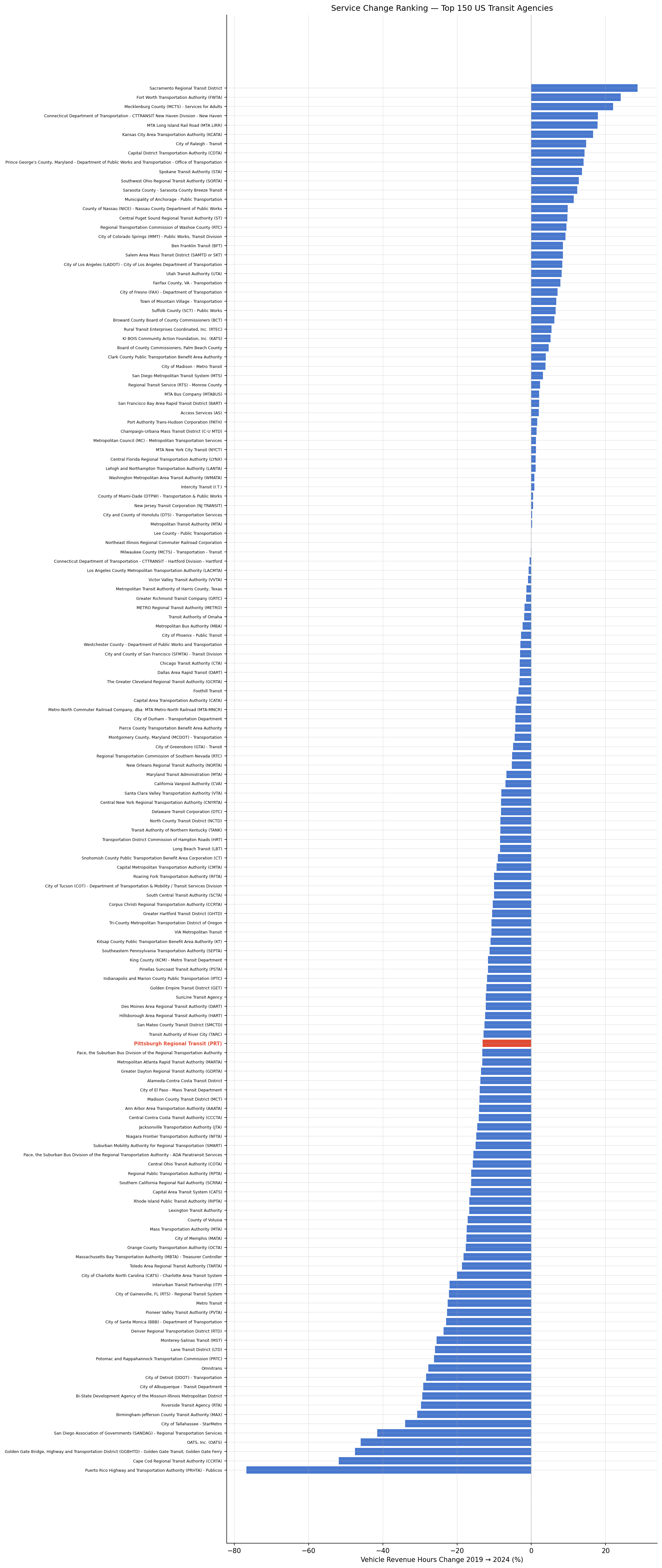
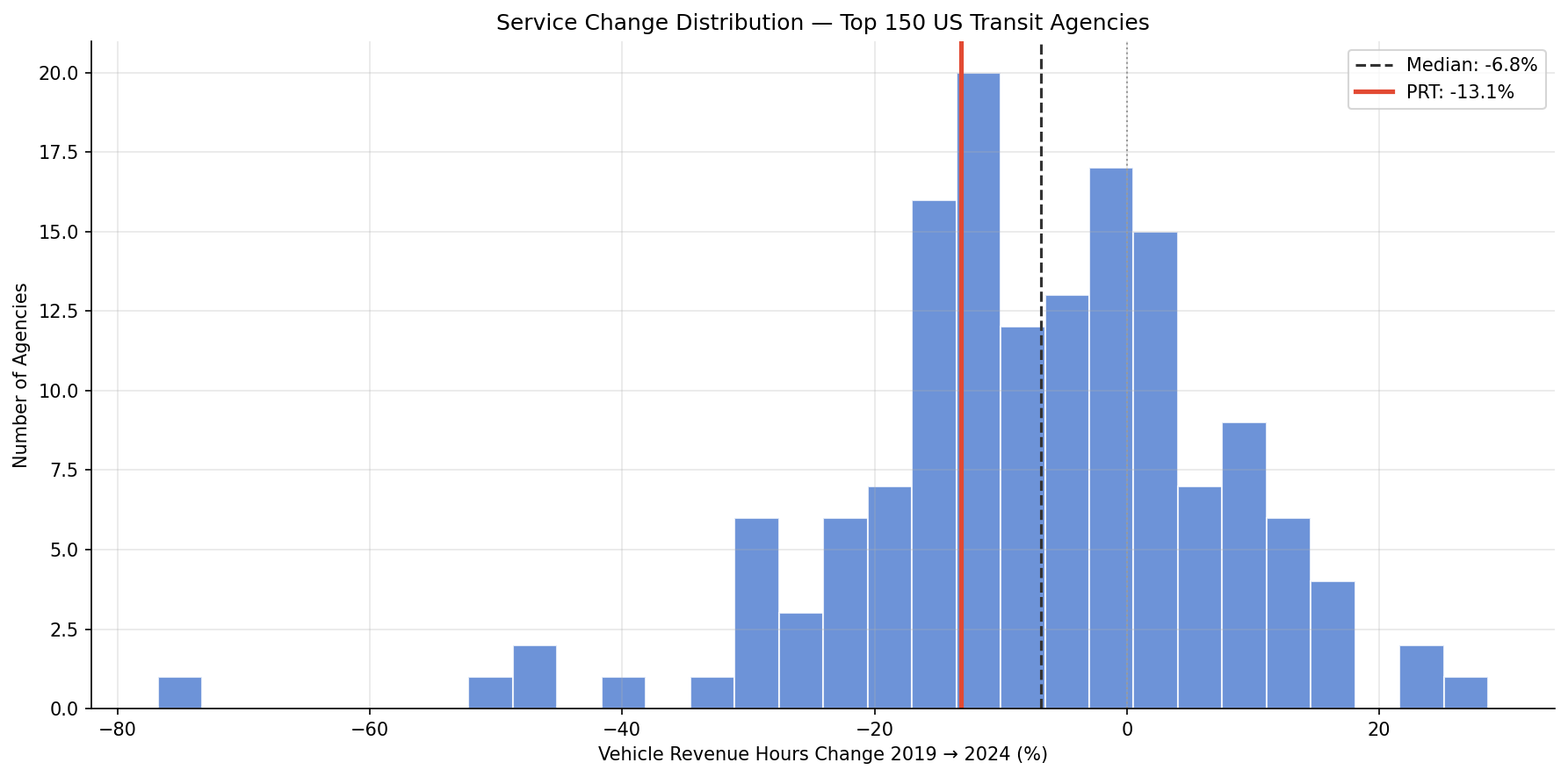
PRT cut 13.1% of vehicle revenue hours between 2019 and 2024, ranking 104th of 150 large US transit agencies (worse than the -6.8% median). However, PRT's ridership dropped 40.8% over the same period — a 27.7 pp gap that strongly suggests the ridership decline is primarily a demand-side problem, not a consequence of service cuts.

Key Numbers

  • PRT VRH change: -13.1% (2,382,972 → 2,070,196 hours)
  • PRT UPT change: -40.8% (64.0M → 37.9M trips)
  • PRT VRH rank: 104th of 150 (1st = best recovery)
  • National median VRH change: -6.8%
  • Agencies recovered to 2019 VRH: 48 of 150 (32%)
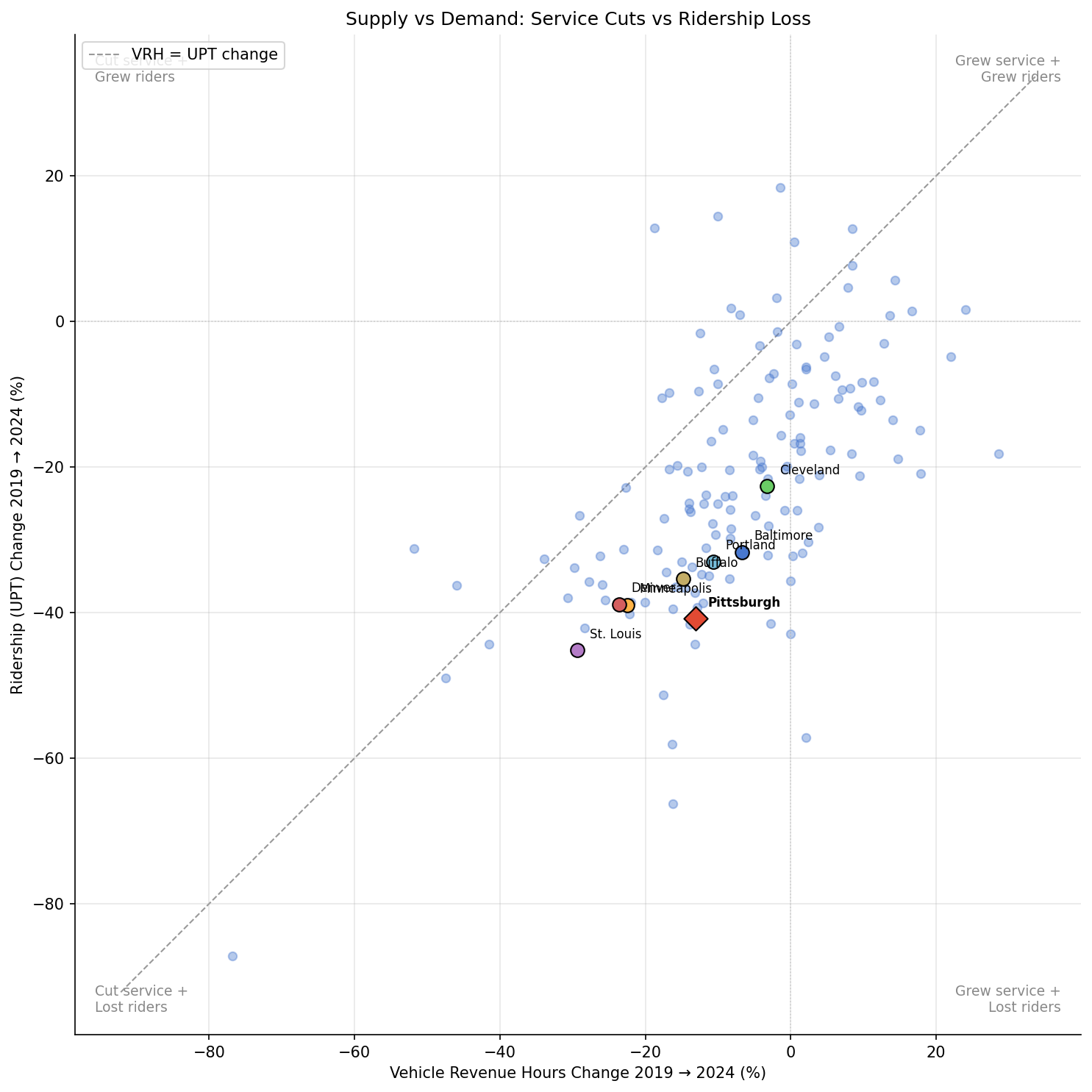
  • Supply–demand gap: 130 of 150 agencies lost more riders than service (below the y=x diagonal)

Observations

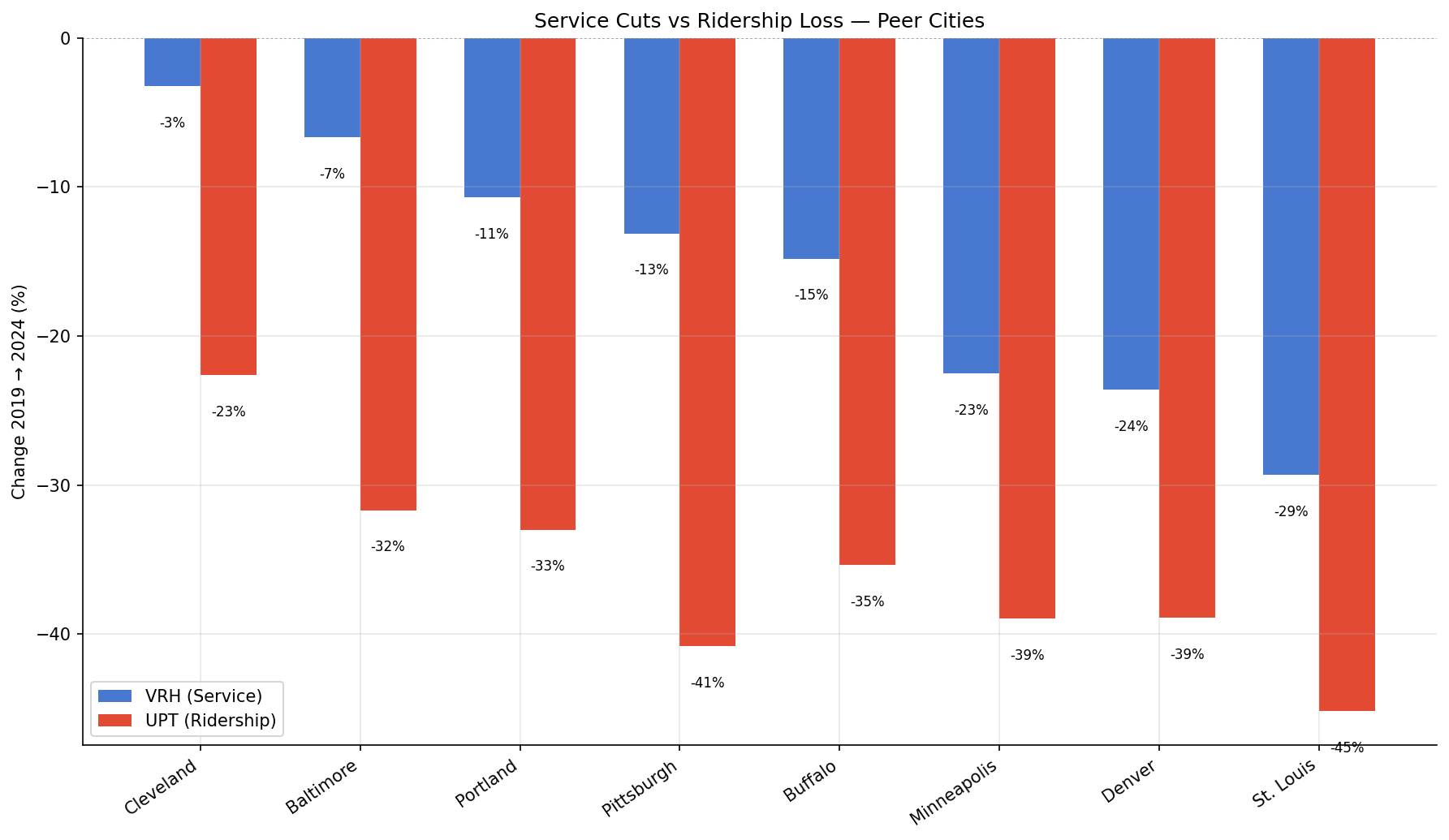
  • PRT's ridership problem is demand-driven. PRT cut 13% of service hours but lost 41% of riders. The 28 pp gap means roughly two-thirds of the ridership loss occurred independently of service reductions. This pattern holds across virtually all peers and nationally.
  • PRT is mid-pack on service cuts among peers. Cleveland cut the least (-3.2%), while St. Louis cut the most (-29.3%). PRT sits between Portland (-10.7%) and Buffalo (-14.8%).
  • Denver and Minneapolis cut service aggressively. Both cut 23–24% of VRH, among the steepest cuts in the peer group, but their ridership losses (-39%) were proportionally smaller relative to the service reductions compared to East Coast peers.
  • Supply–demand gaps vary significantly. Cleveland maintained 97% of service but lost 23% of riders (19 pp gap). Baltimore cut 7% but lost 32% (25 pp gap). The gap ranges from 15 pp (Denver) to 28 pp (Pittsburgh) among peers.
  • Service recovery is slow but ongoing. By 2024, 48 of 150 agencies (32%) had recovered to 2019 VRH levels, up from 26 (17%) at the 2023 mark. The median cut narrowed from -10.8% to -6.8%, indicating gradual national service restoration.
  • Service growth does not guarantee ridership recovery. Of the 48 agencies that grew VRH, many still have not recovered ridership. Sacramento grew VRH by 29% but still lost riders.
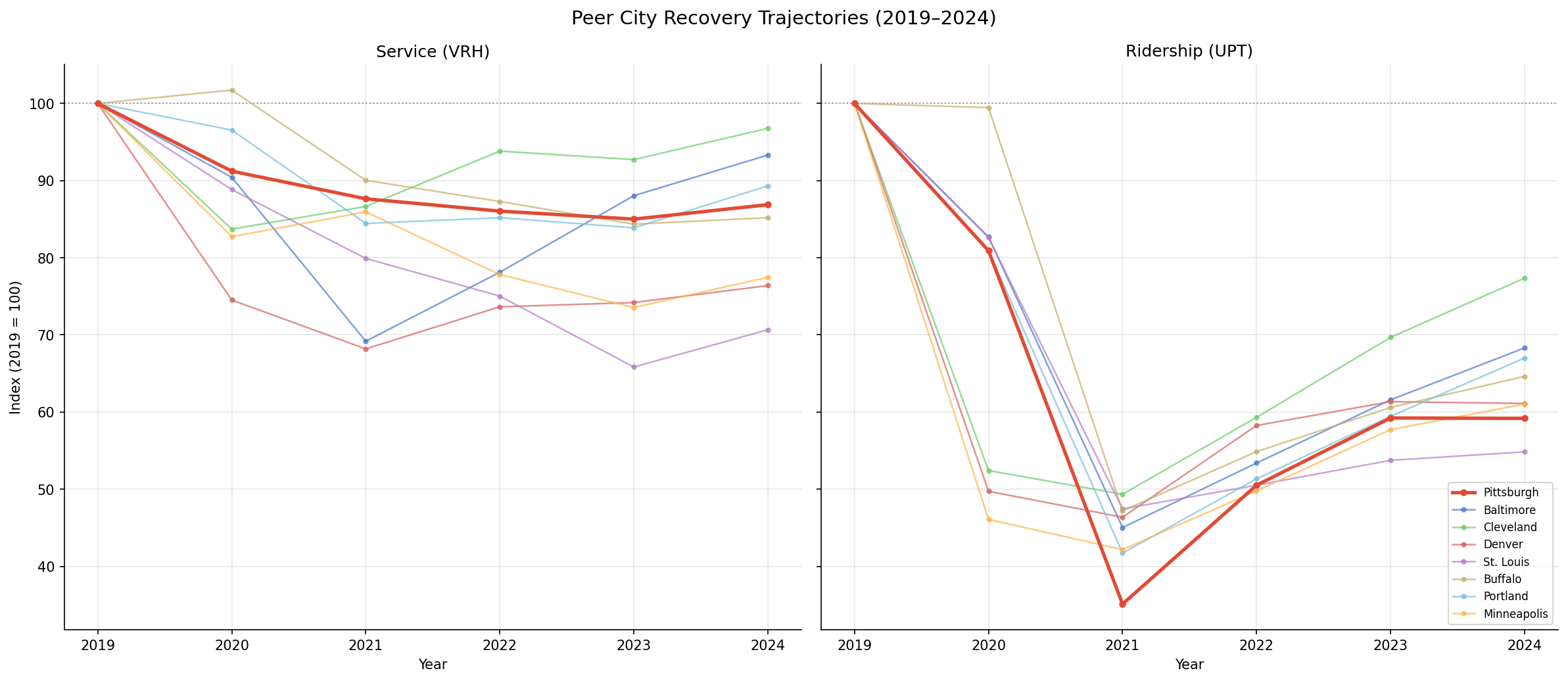
  • Trajectory charts reveal distinct recovery shapes. Cleveland's VRH barely dipped and recovered quickly (V-shape), while St. Louis and Denver show L-shaped stagnation at ~70–75% of 2019 levels. PRT's service trajectory shows a gradual decline through 2023 followed by a modest uptick in 2024 — not the sharp COVID-era drop-and-bounce seen in some peers. Ridership trajectories are uniformly worse: all peers collapsed to 40–60% of baseline in 2020 and have only partially recovered, with Pittsburgh among the slowest to rebound.

Discussion

The dominant national pattern is that transit agencies lost far more riders than they cut service. This suggests the post-COVID ridership shortfall is primarily driven by changed travel patterns (remote work, shifted commuting) rather than by service austerity. PRT fits this pattern: even if all 2019 service hours were restored tomorrow, the data suggests ridership would remain well below 2019 levels.

That said, service cuts and ridership loss are not fully independent. Reduced frequency makes transit less attractive, creating a feedback loop: cut service → longer waits → some riders leave → further cuts seem justified. The 13% VRH reduction likely contributed some portion of the 41% ridership loss, but the cross-agency evidence shows the demand shift is the larger driver.

Among peers, the agencies with the smallest service cuts (Cleveland, Baltimore) do not consistently show the best ridership recovery, reinforcing that supply restoration alone is insufficient.

Caveats

  • System-level aggregation. The TS2.2 data combines all modes and types of service into a single VRH figure per agency. PRT's bus vs. rail service changes cannot be separated in this dataset.
  • VRH measures scheduled service, not effective service. An agency could maintain VRH while degrading reliability, frequency, or coverage in ways that don't appear in this metric.
  • No causal claim. The supply–demand gap does not prove that service cuts had no effect on ridership — only that the ridership decline substantially exceeds what service reductions alone could explain.

Validation

  • Data source verified. VRH and UPT from ntd_annual_service table, loaded from FTA TS2.2 workbooks (2023 + 2024 editions) via pipeline 06.
  • Aggregates sanity-checked. PRT 2019 UPT (64.0M) matches NTD monthly data aggregation from Analysis 36. Top agencies by VRH (NYCT, NJT, WMATA, CTA) are consistent with known largest US transit systems.
  • Direction of effects checked. VRH and UPT both declined for most agencies (expected post-COVID). Agencies with positive VRH growth (Sacramento, Fort Worth) are known to have expanded service.
  • Surprising results investigated. PRT's VRH partially recovered from -15.0% (2023) to -13.1% (2024), consistent with PRT's reported incremental service restorations.

Output
Methods

Methods: National Service Cuts (2019 vs 2024)

Question

How much service have the largest US transit agencies cut since 2019, where does PRT rank, and how does supply-side service change compare to demand-side ridership change?

Approach

  1. Load annual VRH (Vehicle Revenue Hours) and UPT (Unlinked Passenger Trips) from ntd_annual_service for 2019 and 2024.
  2. Filter to agencies with non-null VRH in both years.
  3. Rank agencies by 2019 VRH (descending) and take the top 150 to match Analysis 36's size-based approach.
  4. Compute percent change in VRH and UPT for each agency.
  5. Rank PRT nationally by VRH percent change (best recovery = rank 1).
  6. Compare PRT to 7 peer cities (Baltimore, Cleveland, Denver, St. Louis, Buffalo, Portland, Minneapolis) on both VRH and UPT change.
  7. Plot year-by-year VRH and UPT trajectories (indexed to 2019 = 100) for all 8 peer cities to reveal recovery shape and timing.
  8. Classify agencies into quadrants based on whether they lost more service (VRH) or more riders (UPT) relative to each other.

Data

Name Description Source
ntd_annual_service Annual VRH, VRM, UPT, VOMS per agency (1991–2024) prt.db table (pipeline 06, TS2.2 2023+2024 editions)

Output

File Description
service_cuts_distribution.png Histogram of VRH % change across 150 agencies, PRT highlighted
service_cuts_ranking.png Horizontal bar chart ranking 150 agencies by VRH % change
peer_service_vs_ridership.png Grouped bars: VRH change vs UPT change for 8 peer cities
peer_trajectory.png Side-by-side line charts: VRH and UPT indexed to 2019=100 for 8 peer cities
supply_vs_demand_scatter.png Scatter plot: VRH change (x) vs UPT change (y) for top 150, with y=x diagonal
service_cuts_data.csv Per-agency data with VRH and UPT changes and ranks

Source Code

"""Compare 2019-to-2024 service changes (VRH) across 150 largest US transit agencies; rank PRT."""

import polars as pl

from prt_otp_analysis.common import PEERS, PRE_COVID_BASELINE_YEAR, analysis_dir, get_db, phase, run_analysis, save_chart, save_csv, setup_plotting

OUT = analysis_dir(__file__)

PRT_NTD_ID = 30022
TOP_N = 150


def load_service_data(conn) -> pl.DataFrame:
    """Load VRH and UPT for 2019 and 2024, pivot to wide format."""
    rows = conn.execute("""
        SELECT ntd_id, agency_name, city, state, year, vrh, upt
        FROM ntd_annual_service
        WHERE year IN (?, 2024)
          AND vrh IS NOT NULL
    """, (int(PRE_COVID_BASELINE_YEAR),)).fetchall()
    df = pl.DataFrame([dict(r) for r in rows])

    # Pivot to one row per agency with vrh_2019, vrh_2024, upt_2019, upt_2024
    vrh_wide = (
        df.select("ntd_id", "agency_name", "city", "state", "year", "vrh")
        .pivot(on="year", index=["ntd_id", "agency_name", "city", "state"], values="vrh")
        .rename({"2019": "vrh_2019", "2024": "vrh_2024"})
    )
    upt_wide = (
        df.select("ntd_id", "year", "upt")
        .pivot(on="year", index="ntd_id", values="upt")
        .rename({"2019": "upt_2019", "2024": "upt_2024"})
    )

    wide = vrh_wide.join(upt_wide, on="ntd_id", how="left")

    # Keep only agencies with VRH data in both years
    wide = wide.filter(
        pl.col("vrh_2019").is_not_null() & pl.col("vrh_2024").is_not_null()
    )

    return wide


@run_analysis(39, "National Service Cuts (2019 vs 2024)")
def main():
    plt = setup_plotting()
    conn = get_db()

    # Load data
    with phase("Loading service data"):
        wide = load_service_data(conn)

        # Load annual time-series for peer cities (for trajectory chart)
        peer_ids = list(PEERS.keys())
        ts_rows = conn.execute("""
            SELECT ntd_id, year, vrh, upt
            FROM ntd_annual_service
            WHERE ntd_id IN ({})
              AND year BETWEEN ? AND 2024
              AND vrh IS NOT NULL
        """.format(",".join("?" * len(peer_ids))),
            peer_ids + [int(PRE_COVID_BASELINE_YEAR)],
        ).fetchall()
        peer_ts_df = pl.DataFrame([dict(r) for r in ts_rows])

        conn.close()
        print(f"   {len(wide)} agencies with VRH data in both 2019 and 2024")

    # Rank by 2019 VRH and take top N
    wide = wide.sort("vrh_2019", descending=True).head(TOP_N)
    print(f"   Top {TOP_N} by 2019 VRH selected")

    # Compute percent changes
    wide = wide.with_columns(
        vrh_pct_change=((pl.col("vrh_2024") - pl.col("vrh_2019")) / pl.col("vrh_2019") * 100),
        upt_pct_change=((pl.col("upt_2024") - pl.col("upt_2019")) / pl.col("upt_2019") * 100),
    )

    # Rank by VRH change (best recovery = rank 1)
    wide = wide.sort("vrh_pct_change", descending=True).with_row_index("rank", offset=1)
    wide = wide.with_columns(pl.col("rank").cast(pl.Int64))

    result = wide.select(
        "rank", "ntd_id", "agency_name", "city", "state",
        "vrh_2019", "vrh_2024", "vrh_pct_change",
        "upt_2019", "upt_2024", "upt_pct_change",
    )

    # Summary statistics
    vrh_pct = result["vrh_pct_change"]
    median_vrh = vrh_pct.median()
    mean_vrh = vrh_pct.mean()
    q25 = vrh_pct.quantile(0.25)
    q75 = vrh_pct.quantile(0.75)
    recovered = result.filter(pl.col("vrh_pct_change") >= 0)

    print("\n2. VRH change summary:")
    print(f"   Median change: {median_vrh:.1f}%")
    print(f"   Mean change:   {mean_vrh:.1f}%")
    print(f"   IQR:           {q25:.1f}% to {q75:.1f}%")
    print(f"   Recovered to 2019 levels: {len(recovered)} / {TOP_N}")

    # PRT results
    prt = result.filter(pl.col("ntd_id") == PRT_NTD_ID)
    if len(prt) > 0:
        prt_row = prt.row(0, named=True)
        print(f"\n   PRT: rank {prt_row['rank']}/{TOP_N}, "
              f"VRH {prt_row['vrh_pct_change']:+.1f}%, "
              f"UPT {prt_row['upt_pct_change']:+.1f}%")
        print(f"   VRH: {prt_row['vrh_2019']:,.0f} → {prt_row['vrh_2024']:,.0f}")
        print(f"   UPT: {prt_row['upt_2019']:,.0f} → {prt_row['upt_2024']:,.0f}")
    else:
        print("\n   WARNING: PRT not found in top 150")
        prt_row = None

    # Save CSV
    print()
    save_csv(result, OUT / "service_cuts_data.csv")

    # --- Chart 1: VRH change histogram ---
    with phase("Generating VRH change histogram"):
        fig, ax = plt.subplots(figsize=(12, 6))
        ax.hist(vrh_pct.to_list(), bins=30, color="#4878CF", edgecolor="white", alpha=0.8)
        ax.axvline(median_vrh, color="#333333", linestyle="--", linewidth=1.5,
                   label=f"Median: {median_vrh:.1f}%")
        ax.axvline(0, color="#999999", linestyle=":", linewidth=1)
        if prt_row:
            prt_vrh_pct = prt_row["vrh_pct_change"]
            ax.axvline(prt_vrh_pct, color="#E24A33", linestyle="-", linewidth=2.5,
                       label=f"PRT: {prt_vrh_pct:+.1f}%")
        ax.set_xlabel("Vehicle Revenue Hours Change 2019 → 2024 (%)")
        ax.set_ylabel("Number of Agencies")
        ax.set_title(f"Service Change Distribution — Top {TOP_N} US Transit Agencies")
        ax.legend()
        save_chart(fig, OUT / "service_cuts_distribution.png")

    # --- Chart 2: Ranking bar chart ---
    with phase("Generating ranking bar chart"):
        sorted_df = result.sort("vrh_pct_change")
        agencies = sorted_df["agency_name"].to_list()
        changes = sorted_df["vrh_pct_change"].to_list()
        ntd_ids = sorted_df["ntd_id"].to_list()
        colors = ["#E24A33" if nid == PRT_NTD_ID else "#4878CF" for nid in ntd_ids]

        fig, ax = plt.subplots(figsize=(14, max(30, TOP_N * 0.22)))
        ax.barh(range(len(agencies)), changes, color=colors, height=0.8)
        ax.set_yticks(range(len(agencies)))
        ax.set_yticklabels(agencies, fontsize=6)
        ax.set_xlabel("Vehicle Revenue Hours Change 2019 → 2024 (%)")
        ax.set_title(f"Service Change Ranking — Top {TOP_N} US Transit Agencies")
        ax.axvline(0, color="#999999", linestyle=":", linewidth=1)

        if prt_row:
            prt_idx = [i for i, nid in enumerate(ntd_ids) if nid == PRT_NTD_ID]
            if prt_idx:
                ax.get_yticklabels()[prt_idx[0]].set_color("#E24A33")
                ax.get_yticklabels()[prt_idx[0]].set_fontweight("bold")
                ax.get_yticklabels()[prt_idx[0]].set_fontsize(7)

        save_chart(fig, OUT / "service_cuts_ranking.png")

    # --- Chart 3: Peer city VRH vs UPT change ---
    with phase("Generating peer city comparison"):
        peer_ids = list(PEERS.keys())
        peer_map = pl.DataFrame({
            "ntd_id": list(PEERS.keys()),
            "city_label": list(PEERS.values()),
        })
        peer_data = result.filter(pl.col("ntd_id").is_in(peer_ids))
        peer_data = peer_data.join(peer_map, on="ntd_id", how="left")
        peer_data = peer_data.sort("vrh_pct_change", descending=True)

        if len(peer_data) > 0:
            cities = peer_data["city_label"].to_list()
            vrh_changes = peer_data["vrh_pct_change"].to_list()
            upt_changes = peer_data["upt_pct_change"].to_list()

            fig, ax = plt.subplots(figsize=(12, 7))
            x = range(len(cities))
            width = 0.35

            bars_vrh = ax.bar([i - width / 2 for i in x], vrh_changes, width,
                              label="VRH (Service)", color="#4878CF")
            bars_upt = ax.bar([i + width / 2 for i in x], upt_changes, width,
                              label="UPT (Ridership)", color="#E24A33")

            ax.set_xticks(list(x))
            ax.set_xticklabels(cities, rotation=35, ha="right")
            ax.axhline(0, color="#999999", linestyle=":", linewidth=1)
            ax.set_ylabel("Change 2019 → 2024 (%)")
            ax.set_title("Service Cuts vs Ridership Loss — Peer Cities")
            ax.legend()

            for i, (v, u) in enumerate(zip(vrh_changes, upt_changes)):
                ax.text(i - width / 2, v - 2 if v < 0 else v + 1,
                        f"{v:+.0f}%", ha="center", va="top" if v < 0 else "bottom", fontsize=8)
                ax.text(i + width / 2, u - 2 if u < 0 else u + 1,
                        f"{u:+.0f}%", ha="center", va="top" if u < 0 else "bottom", fontsize=8)

            save_chart(fig, OUT / "peer_service_vs_ridership.png")

            print("\n   Peer city details:")
            for row in peer_data.iter_rows(named=True):
                marker = " <<<" if row["ntd_id"] == PRT_NTD_ID else ""
                gap = row["vrh_pct_change"] - row["upt_pct_change"]
                print(f"   {row['city_label']:<15s} VRH: {row['vrh_pct_change']:>+6.1f}%  "
                      f"UPT: {row['upt_pct_change']:>+6.1f}%  "
                      f"gap: {gap:>+6.1f} pp{marker}")
        else:
            print("   WARNING: No peer cities found in top 150")

    # --- Chart 4: Peer city trajectory (indexed line charts) ---
    with phase("Generating peer city trajectory"):
        peer_map = {nid: label for nid, label in PEERS.items()}
        peer_colors = {
            "Pittsburgh": "#E24A33",
            "Baltimore": "#4878CF",
            "Cleveland": "#6ACC65",
            "Denver": "#D65F5F",
            "St. Louis": "#B47CC7",
            "Buffalo": "#C4AD66",
            "Portland": "#77BEDB",
            "Minneapolis": "#FFB347",
        }

        # Index each city to 2019 = 100
        baseline_df = peer_ts_df.filter(pl.col("year") == int(PRE_COVID_BASELINE_YEAR))
        indexed_df = peer_ts_df.join(
            baseline_df.select(
                "ntd_id",
                vrh_base=pl.col("vrh"),
                upt_base=pl.col("upt"),
            ),
            on="ntd_id",
        ).with_columns(
            vrh_idx=(pl.col("vrh") / pl.col("vrh_base") * 100),
            upt_idx=(pl.col("upt") / pl.col("upt_base") * 100),
        ).with_columns(
            city_label=pl.col("ntd_id").replace_strict(peer_map),
        ).sort("year")

        fig, (ax_vrh, ax_upt) = plt.subplots(1, 2, figsize=(16, 7), sharey=True)

        for city_label in peer_map.values():
            city_df = indexed_df.filter(pl.col("city_label") == city_label)
            years = city_df["year"].to_list()
            color = peer_colors.get(city_label, "#333333")
            is_prt = city_label == "Pittsburgh"
            lw = 2.5 if is_prt else 1.2
            alpha = 1.0 if is_prt else 0.7
            zorder = 3 if is_prt else 2

            ax_vrh.plot(years, city_df["vrh_idx"].to_list(),
                        color=color, linewidth=lw, alpha=alpha, zorder=zorder,
                        label=city_label, marker="o", markersize=4 if is_prt else 3)
            ax_upt.plot(years, city_df["upt_idx"].to_list(),
                        color=color, linewidth=lw, alpha=alpha, zorder=zorder,
                        label=city_label, marker="o", markersize=4 if is_prt else 3)

        for ax, title in [(ax_vrh, "Service (VRH)"), (ax_upt, "Ridership (UPT)")]:
            ax.axhline(100, color="#999999", linestyle=":", linewidth=1, zorder=1)
            ax.set_xlabel("Year")
            ax.set_title(title)
            ax.set_xticks(list(range(int(PRE_COVID_BASELINE_YEAR), 2025)))

        ax_vrh.set_ylabel("Index (2019 = 100)")
        ax_upt.legend(loc="lower right", fontsize=8)
        fig.suptitle("Peer City Recovery Trajectories (2019–2024)", fontsize=14, y=0.98)
        fig.tight_layout()
        save_chart(fig, OUT / "peer_trajectory.png")

    # --- Chart 5: Supply vs demand scatter ---
    with phase("Generating supply vs demand scatter"):
        scatter_data = result.filter(
            pl.col("vrh_pct_change").is_not_null() & pl.col("upt_pct_change").is_not_null()
        )

        fig, ax = plt.subplots(figsize=(10, 10))

        # All agencies
        vrh_vals = scatter_data["vrh_pct_change"].to_list()
        upt_vals = scatter_data["upt_pct_change"].to_list()
        ax.scatter(vrh_vals, upt_vals, color="#4878CF", alpha=0.4, s=30, zorder=2)

        # Diagonal y=x line
        lim_min = min(min(vrh_vals), min(upt_vals)) - 5
        lim_max = max(max(vrh_vals), max(upt_vals)) + 5
        ax.plot([lim_min, lim_max], [lim_min, lim_max], color="#999999", linestyle="--",
                linewidth=1, zorder=1, label="VRH = UPT change")

        # Highlight peer cities
        peer_colors = {
            "Pittsburgh": "#E24A33",
            "Baltimore": "#4878CF",
            "Cleveland": "#6ACC65",
            "Denver": "#D65F5F",
            "St. Louis": "#B47CC7",
            "Buffalo": "#C4AD66",
            "Portland": "#77BEDB",
            "Minneapolis": "#FFB347",
        }
        for row in peer_data.iter_rows(named=True):
            label = row["city_label"]
            color = peer_colors.get(label, "#333333")
            marker_size = 120 if row["ntd_id"] == PRT_NTD_ID else 80
            marker_shape = "D" if row["ntd_id"] == PRT_NTD_ID else "o"
            ax.scatter(row["vrh_pct_change"], row["upt_pct_change"],
                       color=color, s=marker_size, marker=marker_shape,
                       edgecolors="black", linewidths=1, zorder=3)
            ax.annotate(label,
                        (row["vrh_pct_change"], row["upt_pct_change"]),
                        textcoords="offset points", xytext=(8, 8), fontsize=8,
                        fontweight="bold" if row["ntd_id"] == PRT_NTD_ID else "normal")

        # Quadrant labels
        ax.text(0.02, 0.02, "Cut service +\nLost riders",
                transform=ax.transAxes, fontsize=9, color="#888888", va="bottom")
        ax.text(0.98, 0.02, "Grew service +\nLost riders",
                transform=ax.transAxes, fontsize=9, color="#888888", va="bottom", ha="right")
        ax.text(0.02, 0.98, "Cut service +\nGrew riders",
                transform=ax.transAxes, fontsize=9, color="#888888", va="top")
        ax.text(0.98, 0.98, "Grew service +\nGrew riders",
                transform=ax.transAxes, fontsize=9, color="#888888", va="top", ha="right")

        ax.axhline(0, color="#CCCCCC", linestyle=":", linewidth=0.8)
        ax.axvline(0, color="#CCCCCC", linestyle=":", linewidth=0.8)
        ax.set_xlabel("Vehicle Revenue Hours Change 2019 → 2024 (%)")
        ax.set_ylabel("Ridership (UPT) Change 2019 → 2024 (%)")
        ax.set_title("Supply vs Demand: Service Cuts vs Ridership Loss")
        ax.legend(loc="upper left")
        ax.set_aspect("equal", adjustable="datalim")
        save_chart(fig, OUT / "supply_vs_demand_scatter.png")

        # Quadrant summary
        above_diag = scatter_data.filter(
            pl.col("upt_pct_change") > pl.col("vrh_pct_change")
        )
        below_diag = scatter_data.filter(
            pl.col("upt_pct_change") <= pl.col("vrh_pct_change")
        )
        print(f"\n   Above diagonal (ridership outpaced service): {len(above_diag)}")
        print(f"   Below diagonal (service outpaced ridership): {len(below_diag)}")

    # Top and bottom 10
    print("\n8. Top 10 service recoveries:")
    for row in result.head(10).iter_rows(named=True):
        print(f"   {row['rank']:>3d}. {row['agency_name']:<50s} VRH: {row['vrh_pct_change']:>+7.1f}%")

    print("\n   Bottom 10:")
    for row in result.tail(10).iter_rows(named=True):
        print(f"   {row['rank']:>3d}. {row['agency_name']:<50s} VRH: {row['vrh_pct_change']:>+7.1f}%")


if __name__ == "__main__":
    main()

Sources

NameTypeWhy It MattersOwnerFreshnessCaveat
ntd_annual_service table Primary analytical table used in this page's computations. Produced by NTD Annual Service ETL. Updated when the producing pipeline step is rerun. Coverage depends on upstream source availability and ETL assumptions.
Upstream sources (1)
  • file data/ntd-annual-service/2023_TS2.2_Service_Data.xlsx — NTD TS2.2 workbook with annual service data by system.
polars dependency Runtime dependency required for this page's pipeline or analysis code. Open-source Python ecosystem maintainers. Version pinned by project environment until dependency updates are applied. Library updates may change behavior or defaults.
matplotlib dependency Runtime dependency required for this page's pipeline or analysis code. Open-source Python ecosystem maintainers. Version pinned by project environment until dependency updates are applied. Library updates may change behavior or defaults.